
3/13/26
Dear Ones of Christ Church,
Our gospel readings from John this season feature encounters with Jesus that bring about questions and the seeking of answers. Nicodemus, the Samaritan woman at the well, and this weekend, the man born blind, all meet Jesus and have their lives changed by questions—their questions, Jesus’s questions, and the questions of those around them. So often in our world and culture and lives we want answers. Jesus asks us to live differently. Jesus asks us to live into the questions. Below is a poem from Lucille Clifton that honors a life of questions and answers.
Dear ones, I must share with you that I have been working too many hours (averaging close to 60 per week) these past months, and my health is suffering for it. My care team has advised me that this pace is unsustainable, particularly given the cancer treatment medication I must continue to take, which causes me to have chronic fatigue. I have reached out for help from our diocese and also from our vestry.
In the middle to longer term, vestry and myself, with diocesan support, will work together to ask questions, such as: what does a healthy and sustainable ministry of full-time priesthood look like at Christ Church, and how do we live into that together? In the short term, the Rev. Canon Kelly O’Connell and Bishop Julia have given me the pastoral guidance to take an extra day off each week through the beginning of April, and during Holy Week, to only celebrate and preach Palm Sunday and Easter weekend services with you. Our Holy Week services Wednesday through Friday will be led by lay leaders, Deacon James and Deacon Natalie, and a guest priest to celebrate Maundy Thursday. I am grateful for this support.
Additionally, this coming week I will be away for a planned Lenten retreat from Monday March 16th through Monday March 23rd. I will not have access to internet or cell phone service during this time. Deacon Natalie and Deacon James will lead worship on the weekend of March 21st and 22nd, and we have coverage for emergency pastoral needs. Please know I will be praying for you while I am away, and I covet your prayers as well, for deep rest and restoration, and for all of the listening and questions that intentional time with God may bring.
Yours in Christ,
Melissa+
questions and answers, by Lucille Clifton
what must it be like
to stand so firm, so sure?
in the desert even the saguaro
hold on as long as they can
twisting their arms in
protest or celebration.
you are like me,
understanding the surprise
of jesus, his rough feet
planted on the water
the water lapping
his toes and holding them.
you are like me, like him
perhaps, certain only that
the surest failure
is the unattempted walk.
Source: The Collected Poems of Lucille Clifton 1965-2010 (BOA Editions Limited, 2015). Shared by Sara-Kay Mooney in her 2026 Lenten poetry-sharing series.
3/6/26
Dear Ones of Christ Church,
For our mutual reflection, care, and ministry in this time of war, I commend to you the invitation to prayer below and at this link from our siblings in Christ, the Armed Forces chaplains of the Episcopal Diocese of Long Island. May their witness and words be a balm to you as they have been to me.
Yours in Christ,
Melissa+
An Invitation to Prayer in a Time of War
February 28, 2026
Dear Friends in Christ,
Grace and peace to you.
In the wake of recent U.S. military strikes against Iran, we write to you as the Armed Forces Chaplains of the Diocese of Long Island—pastors who walk daily alongside service members, veterans, and families, and who also stand with you in prayer as members of the Body of Christ.
Moments like this often arrive through an unrelenting stream of alerts, images, commentary, and speculation. The pace itself can become its own source of distress. We invite you, first of all, to pause. To take a breath. To pray.
Prayer in a time of war is not escape. It is grounding. It steadies us when fear seeks to scatter us. It reminds us that behind every uniform and every border are human beings—beloved children of God—on all sides of conflict. It calls us back to our deepest identity before any other name claims us.
We also encourage a gentle attentiveness to how we take in the news. Consider limiting your intake. Choose trusted, measured sources rather than endless scrolling or reactive commentary. Ask yourself why you are checking the news in a given moment: Is it to stay responsibly informed, or is it feeding anxiety, anger, or helplessness? Information has its place. So does restraint. Wisdom often lies in knowing when to turn toward the light of prayer rather than the noise of speculation.
As chaplains, we are reminded daily that readiness is not only a matter of strength or preparedness. It is spiritual. It is the quiet, faithful work of tending the inner life so that anxiety does not isolate us, grief does not harden us, and fear does not eclipse compassion. Return to the practices that root you: prayer, scripture, silence, honest conversation, time with those you love.
Be gentle with one another. Many around you may be carrying unspoken worry. Reach out. Stay connected. Listen deeply. These small acts are not small at all. They are how peace is practiced.
For Christians, prayer in times of war is also an act of faithful resistance. We follow Jesus Christ, the Prince of Peace, whose life reveals that love is stronger than violence and mercy deeper than fear. To pray for peace is not naïve. It is courageous. It is to align our hearts with God’s future even when the present feels uncertain.
We invite you to pray:
For all who live under the shadow of violence.
For those who serve, and for those who wait and worry at home.
For leaders, that wisdom, restraint, and humility may guide their decisions.
For the wounded in body, mind, and spirit.
For a world aching for peace, and for the grace to be instruments of it.
If this moment stirs deep anxiety or distress, please do not carry it alone. Reach out to your clergy. If you are clergy, reach out to a colleague or your spiritual director. Reach out to trusted friends. Seek help when you need it. Caring for our spiritual and emotional well-being is an act of faithfulness.
In this season of Lent:
May the God who brings light out of chaos breathe calm into troubled hearts.
May the Christ who stretched out his arms in love hold all who suffer.
May the Spirit who hovers over the waters guide us in the way of peace.
With prayer and solidarity,
The Armed Forces Chaplains of the Diocese of Long Island
The Rev. Canon Landon Moore, The Rev. Jenn Pilat, The Rev. James Reiss, The Rev. Dr. Benjamin Shambaugh, The Very Rev. Dr. Michael Sniffen
2/20/26
Dear Ones of Christ Church,
Blessed Lent to you. The word Lent can be traced back to an Old English word meaning “to lengthen,” and for us in the Northern hemisphere this 40 day season in our Church calendar corresponds with the daylight hours lengthening, the stems of the first crocuses (yes, they are coming!) lengthening. And so we are asked, too, to lengthen and stretch and turn more intentionally toward God, which involves intentionally turning away from the habits that hinder us from loving God, loving ourselves, and loving our neighbors. Lent is a season when we Christians imitate Jesus’s 40 days in the wilderness. In Lent we prepare, through prayer, penitence, fasting, sacrificial giving, meditation with Holy Scripture, and service, to follow Jesus through the cross-shaped death that leads to new life.
Each year, the Church gives us the gift of Lent, a season that starts by reminding us, on Ash Wednesday, that we are going to die. And then, Lent asks, “How will you live?”
Jesus says this another way, in all four Gospels: “All who want to save their lives will lose them. But all who lose their lives because of me and because of the good news will save them.” (Mark 8:35, see also: Matthew 10:39, Matthew 16:25, Luke 9:24, John 12:25)
This week, whether your heart feels frozen in a winter snow bank or warmed by the sound of the cardinal’s spring song, may you know that God is with you, and may this Lenten season of stretching, and lengthening, and spaciousness bless you richly.
Yours in Christ,
Melissa+
2/13/26
Dear Ones of Christ Church,
This weekend, the last before we enter the season of Lent, we will hear the gospel of Matthew’s version of the Transfiguration. I have been praying with poet Malcolm Guite’s reflection and sonnet on the Transfiguration, which also features art from Rebecca Merry.
Click here to engage and pray with Guite’s and Merry’s art and to hear a reading of the sonnet.
Guite’s sonnet is below. Here are some questions we may want to ponder at this hinge moment in our liturgical year, this time when we will be invited to remember that we are beloved dust, and to follow Jesus down the mountain and into the wilderness of Lent:
Where are you seeking and/or finding the “blaze” of the Light of Christ “leaping up” in you or in others in the world, in this season?
What, or who, has helped you to feel and remember “the Love that dances at the heart of things?” How might God be inviting you more deeply into that Love during Lent? What practices are you being invited to take on, or let go of, during Lent to allow more space to pay attention to, nourish, and connect with God’s Love?
Yours in Christ,
Melissa+
Transfiguration, by Malcolm Guite
For that one moment, ‘in and out of time’,
On that one mountain where all moments meet,
The daily veil that covers the sublime
In darkling glass fell dazzled at his feet.
There were no angels full of eyes and wings
Just living glory full of truth and grace.
The Love that dances at the heart of things
Shone out upon us from a human face
And to that light the light in us leaped up,
We felt it quicken somewhere deep within,
A sudden blaze of long-extinguished hope
Trembled and tingled through the tender skin.
Nor can this blackened sky, this darkened scar
Eclipse that glimpse of how things really are.
Published in Sounding the Seasons: One Hundred and Ten Sonnets for the Christian Year, Enlarged Edition, Canterbury Press, 2024.
2/6/26
This weekend as we gather for worship and for our annual meeting on Sunday, we will hear Jesus calling us salt and light, ordinary elements of our everyday lives that bring change—salt changes the taste of things, melts things. Light offers new perspectives. In this time of change that we are living in together, how can we seek to be agents of God’s will and God’s change? How is Jesus calling us to be salty light-bearers today?
I engage with some of these questions in my annual report —as preparation for annual meeting, and as a devotional practice, I invite you to read and pray with our 2025 annual report, linked here and further down in Keeping Connected. With deep gratitude, join me in praying for our parish, our staff, our ministries and our many leaders and volunteers. And as we gather for annual meeting, I invite us to ponder and pray about these questions:
- How do you hear Jesus calling you to be salt and light, in your life?
- How do you hear Jesus calling us as a parish to be salt and light, together?
- Salt melts—in our ministry together, what structures might be freezing us in place and might need to be melted and transformed by our saltiness?
- Light shines—how will we continue to shine Christ’s light brightly with and for others in our community?
I look forward to being together, praying together, ministering together.
Yours in Christ,
Melissa+
1/30/26
Dear Ones of Christ Church,
As I write this, the sunlight reflecting off the snow shines brightly, and I crave its light, its warmth. In these bitterly cold days of winter, amid the heartbreaking violence in Minnesota and throughout our country, violence that harms and wounds the souls and bodies of victims, perpetrators, and witnesses, I turn my face toward the light of the sun, and toward the Light of Christ.
Jesus tells us and shows us how to respond faithfully in times of deep grief and heartbreak and violence.
In last Sunday’s gospel reading, after his teacher and mentor John the Baptist was unjustly arrested by the authorities of his time, Jesus “withdrew to Galilee” and called his first disciples. He did not withdraw and remain isolated by fear or grief—he withdrew and sought out others—disciples—inviting them to “follow” him in his ministry of teaching, of healing, and of proclaiming the good news of the nearness of God’s kingdom.
This weekend we will hear the Beatitudes from the gospel of Matthew. We will hear Jesus name the blessedness of the spiritually poor, the mourners, and the meek. The blessedness of those who hunger for righteousness. The blessedness of the merciful, the pure in heart, the peacemakers, the persecuted.
I invite us, in these days that are wintry on many levels, to keep turning our faces toward the Light of Christ, to be fed by Jesus’s presence in Word and Sacrament and one another, and to learn from him and his blessing, healing, nourishing, merciful, peacemaking way of the Cross, his Good News way of costly discipleship in solidarity with the most vulnerable. We are invited to follow him on this way, with the particular God-given gifts that we have, together.
I invite us, always, to pray. When you do not have the words, The Great Litany may be helpful, as may be the prayer below from Pádraig Ó Tuama.
Yours in Christ,
Melissa+
“A prayer in times of violence,” by Pádraig Ó Tuama, from the book Daily Prayer with the Corrymeela Community. Canterbury Press, Norwich: 2017. p. 43.
God of all humanity,
in times of violence
we see how inhuman we can be.
We pray for those who, today, are weighed down by grief.
We pray for those who, yesterday, were weighed down by grief.
And the day before,
and all the days before the day before.
We pray, too, for those who help us turn toward justice and peace.
Turn us all towards justice and peace
because we need it.
Amen.
1/23/26
Dear Ones of Christ Church,
This bitterly cold weekend, if your Christmas decorations are still up, if you are still in need of their light, or if you simply have not had the time to pack them up, leave them. While some take down their Christmas decorations after the Feast of the Epiphany on January 6th, many Christians around the world leave their mangers and lights up until February 2nd, the Feast of the Presentation, also known as Candlemas. The Feast of the Presentation is a different and later end to the Christmas season, when the last story of Jesus’s infancy in the gospel of Luke is read, about Jesus’s presentation in the temple, when the prophets Anna and Simeon witness and proclaim the Christ child’s light.
These Feasts of the Incarnation, the Epiphany, and the Presentation all share a theme of light. This is a season of light, when we remember and name Jesus as the Light of the World, shining on and in and through us.
In this weekend’s lectionary readings we will hear these words from the prophet Isaiah, twice:
“The people who walked in darkness
have seen a great light;
those who lived in a land of deep darkness--
on them light has shined.”
We will also hear Jesus tell his disciples that he will make them fishers of people. When I think about the intersection of fish and this season of Christ’s light, I think about the shininess of fish scales, and the ways schools of fish swim together, and create light simply by being who and what God has created them to be. I was delighted to learn this week, from the Art and Theology blog, that fish and this season of Christ’s light come together in a traditional Spanish Christmas carol, or villancico, called “En Belén Tocan al Fuego,” which translates loosely to “In Bethlehem they ring the bells of fire,” referring to the practice of sounding an alarm of village church bells when there was a fire—except in the song, the fire is the burning Light of Christ in the manger. The villancico has the following chorus, translated to English:
“Fish in the river are glistening and dancing,
Dancing and leaping to celebrate his birthday.”
You can listen to the carol in its original Spanish here, sung by the Coral Borrianenca, and partially translated to English here, sung by the Women’s Chorale of Calvin University.
May you be warmed by the fire of Christ’s light in these cold days, trusting that it shines in and through you, in and through us.
Yours in Christ,
Melissa+
1/16/26
Dear Ones of Christ Church,
Last weekend in our worship we renewed our Baptismal promises together. One of those promises is to “strive for justice and peace among all people, and respect the dignity of every human being,” with God’s help.
This weekend, I invite you to join me in listening to and reading and praying with the words of our ancestor and exemplar in the Christian faith, the Rev. Dr. Martin Luther King, Jr., who dedicated his life to striving for justice and peace. Below are links to read, or listen to him reading, his Letter from a Birmingham Jail.
It is a long letter—pray and listen or read in sections if it is too long for one sitting. Pray and listen or read in 15 minute segments each morning or afternoon or evening. Listen to the Rev. Dr. King’s voice and words on your commute. Or while you are cooking dinner. Or while you are sitting still or while you are walking.
As you read or listen: What do you notice? What resonates with you? What inspires you or gives you hope? What convicts you or makes you uncomfortable? What do you hear in the Rev. Dr. King’s letter that speaks into our present moment today? What difference does what you have read or heard make for you, and for us, in our lives of following Christ?
Yours in Christ,
Melissa+
Click here to listen to the Rev. Dr. King read his Letter From a Birmingham Jail
Click here for the full text of the Rev. Dr. King’s Letter From a Birmingham Jail
1/9/26

Dear Ones of Christ Church,
Many Epiphanytide blessings to you and yours. Last weekend in our worship services we blessed chalk for the Epiphany tradition of chalking a blessing on the entrances to the places we call home. Some of you have sent me photos of your blessed doors and stairs. These photos have heartened me. In these days when we are experiencing terrible violence and enmity in our nation, we bless our thresholds, renewing our Christian commitment to welcome Jesus as our guest and to share his hospitality with others. Blessed chalk and a guide for blessing are still available at church (on the hallway table in front of you as you enter from the office door). And for those who are spending this season away from Plymouth, you can chalk and bless your own thresholds by using the resource at this link.
This weekend in our worship services we will hear Matthew’s version of the story of Jesus’s Baptism by John in the River Jordan and renew our Baptismal vows as we celebrate the Feast of the Baptism of Our Lord.
Above is an icon of Jesus’s Baptism, by the Ukrainian icon writer Ivanka Demchuk. As you read and pray with Matthew’s account of the Baptism (Matthew 3:13-17), and/or as you pray and meditate with the icon, here are a few questions to ponder:
- What word or phrase in the passage, or what part of the image, catches your attention? How might God be using that word, phrase, or image to speak to you?
- What excites, inspires, or consoles you in the Scripture passage and/or icon? What challenges you or makes you uncomfortable?
- What difference does Jesus’s Baptism make for you, in your own life of discipleship?
Yours in Christ,
Melissa +
12/26/25
Dear Ones of Christ Church,
Blessed Christmas to you! Whether your Christmastide is filled with travel, hosting, or quiet solitude, I pray that you will seek and find God’s provision, peace, and new life, Christ’s light born to us and in us.
On this day between hearing the earthy story of the lowly manger in the Gospel of Luke and the expansive poetic prologue of the Gospel of John (which we will hear this Saturday and Sunday in our worship), I share with you the poem below, by Michael Longley. I love how the poem approaches the mystery of the Incarnation, in Jesus, where heaven and earth meet, through the Lukan scene of Mary and her baby, and the Johannine cosmic Christ.
Yours in Christ,
Melissa+
Birth
By Michael Longley
The cosmos-shaper has come down to earth:
Mary is counting his fingers and toes.
Source: The Candlelight Master (Wake Forest University Press, 2020), shared by Sara Kay Mooney, Christmas 2022.
12/19/25
Dear Ones of Christ Church,
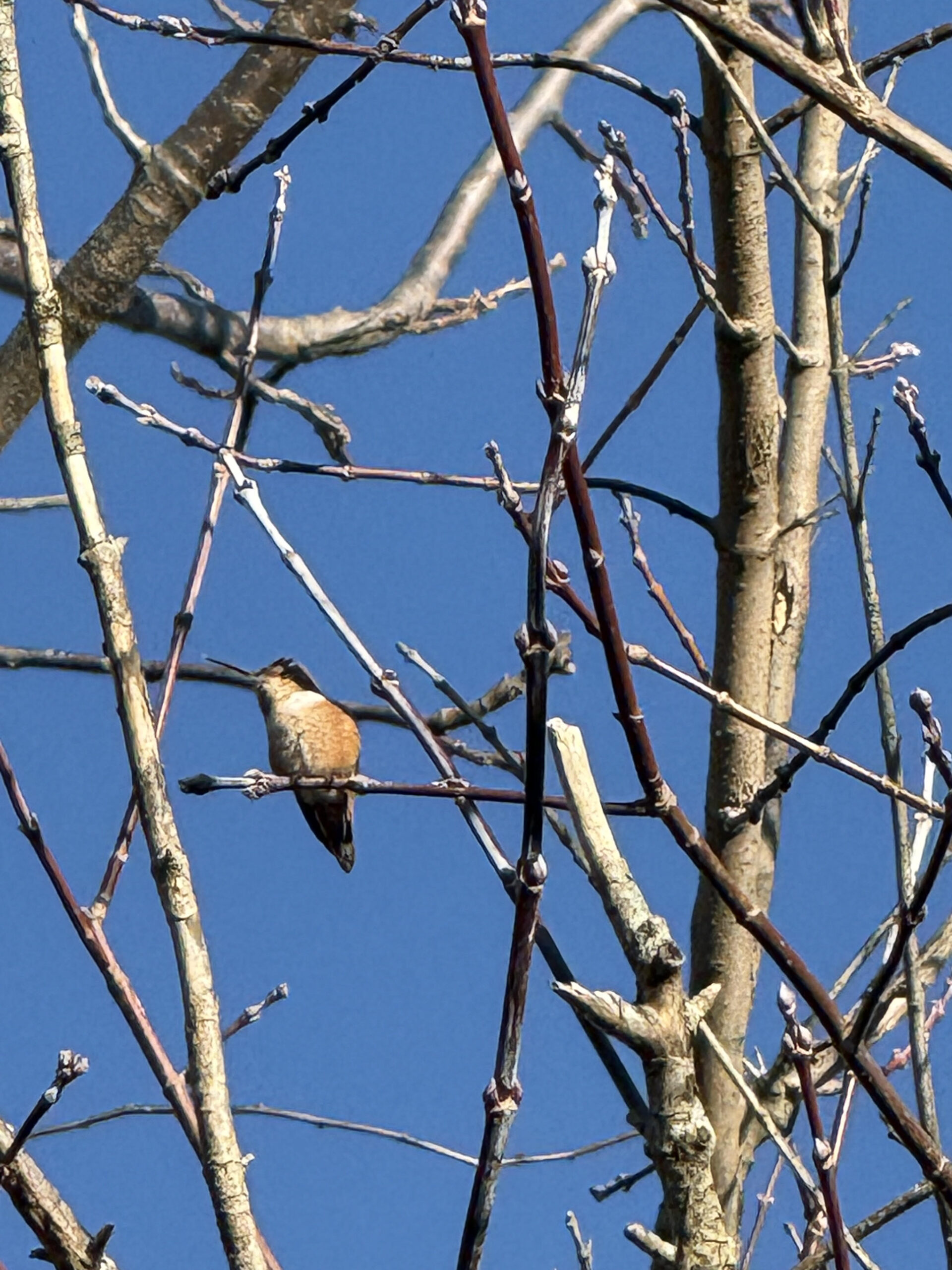
As we enter these last days of Advent, I am increasingly aware of the practice of waiting. Waiting each morning for Rusty the rare over-wintering western hummingbird to come to our heated feeder (yes, for those who heard my sermon back in October that featured Rusty, he is indeed still here, weathering snowstorms and sub-freezing temperatures). Waiting for when Alex and I had time to go get a Christmas tree (it was this past Monday). Waiting for Jesus to arrive, in bread and wine, in beginnings and endings, in the faces and presence of dear ones and neighbors and strangers, in the manger.
A gift I wait for each week during Advent, and again in Lent, is the poem that Sara-Kay Mooney shares each Sunday in these seasons. You can follow “Poems for the Season” through this link to Sara-Kay’s substack to receive these Advent and Lent treasures. This past Sunday she shared a poem about waiting, by Tony Hoagland. It is below, and one of the things I love about this poem is the way Marie’s movement between the hospital and the adoption agency illustrates the paradox of Christian waiting—both its stillness and its activity. Even and especially in the midst of death and the holding of a future that can feel heavy, we are called to keep watch together for resurrection and new life.
May you be blessed in the waiting of these threshold days, in all of your activity and your stillness.
Yours in Christ,
Melissa+
_________________________________________
Migration, by Tony Hoagland
This year Marie drives back and forth
from the hospital room of her dying friend
to the office of the adoption agency.
I bet sometimes she doesn’t know
What threshold she is waiting at—
the hand of her sick friend, hot with fever;
the theoretical baby just a lot of paperwork so far.
But next year she might be standing by a grave,
wearing black with a splash of
banana vomit on it,
the little girl just starting to say Sesame Street
and Cappuccino latte grand Mommy.
The future ours for a while to hold, with its heaviness—
and hope moving from one location to another
like the holy ghost that it is.
Source: What Narcissism Means To Me (Graywolf Press, 2003).
12/12/25
Dear Ones of Christ Church,
A reminder that this weekend at our services on Saturday at 5p and Sunday at 8a, we will celebrate Holy Eucharist as usual, and on Sunday at 10a we will celebrate this season of holy waiting, attentiveness, and preparation with a service of Advent Lessons and Carols.
In all three of these worship services, we will hear the words of prophets, including the Magnificat, the song of the prophet Mary, about the ways God’s powerful actions have been magnified in her life and in the life of the world. Mary is also, of course, the mother of Jesus, and when I pray the Magnificat (Luke 1:46-55), I also hear Jesus’s words in the Beatitudes (Luke 6:20-26).
“[God] has lifted up the lowly,” sings Mary. “Blessed are you who are poor, for yours is the kingdom of God,” says Jesus.
“[God] has filled the hungry with good things,” sings Mary. “Blessed are you who are hungry now, for you will be filled,” says Jesus.
This week I am giving thanks for the prophet Mary’s bold faithfulness, and for how much Jesus must have learned from his blessed mother about who God is, and what God is up to in the world.
I invite you to pray with this video, “Magnificat,” from the SALT Project.
Yours in Christ,
Melissa+
12/5/25
Dear Ones of Christ Church,
It was a gift to gather with so many of you last Sunday to bless and make Advent wreaths in the parish hall. Many thanks to Lynne Neeley for her generous donations of materials and time and teaching. Lynne cut the branches for the wreaths herself from evergreens around her home, and after I made a wreath I loved the way my hands smelled sharply and cleanly of pine pitch and sap.
Talking with Lynne about how she had collected wreath branches for us from her neighbor trees reminded me of a reflection my spiritual director sent me last week by Amy Frykholm, describing how she makes her Advent wreath each year. Here’s an excerpt (you can read her entire reflection here):
For more than 20 years I have been making the same Advent wreath, although it is never an exact replica of the previous year’s attempt. It starts with a dish that can fit four candles around. Then I fill the dish with birdseed.
The next part is the most essential. I go out into the woods or the cemetery or the alleys, and I look for natural shapes and colors that are of the moment. The dried poppy heads are probably my favorite, because after the poppy has bloomed and the petals have fallen off, the remainder looks like a star, with a dark heart like a black hole.
But I also love how different each head of grass is. There is a stunning variety. For color I look for kinnikinnick berries and rose hips. I look for spruce branches and pine cones. The key to this searching is that whatever I find, it speaks to the now and the here. The reason I’ve kept this practice up is because in the deadness of early winter, I find beauty that never fails to surprise me.
I lay this bounty on the birdseed in whatever way inspires me. When Advent is over, I toss the whole thing near the bird feeder for what poet Ada Limón calls the “after party.”
Inspired by Lynne and Amy, on Monday I went out and snipped some rose hips from my garden and added them to our wreath. The wreath is now a holy combination of plants from my home place on the shores of Buzzards Bay, and plants from my church place, on the shores of Plymouth Bay.
This mixing of places seems right in a wreath made to mark a season that calls us to pay attention to the ways Jesus crosses boundaries of space and time and place to arrive among us—to arrive in the past as a baby; to arrive now, in our present encounters with one another, with bread and wine, with creation; and to arrive again in the future to reconcile all things to God at the end of time. Can an Advent wreath hold all of this, theologically? No. Maybe. I don’t know. But there is something about paying attention to the feel of evergreen needles, the scent of pine pitch, the sudden warmth when I cup my hand to light a candle, the sound or silence of a blessing, that helps me to pay attention to the One who holds all things, including us.
Yours in Christ, with Advent blessings,
Melissa+